British Beef and Lamb in 2025: Production, Consumption, Imports and the Question of Fair Competition
Published July 2026

How Self-Sufficient is the UK in the Production of Beef and Sheep Meat? (2025)
The United Kingdom remains a major producer of both beef and sheep meat. Livestock farming makes an important contribution to the rural economy, supports thousands of associated businesses and helps to manage a large proportion of the British countryside.
However, production figures alone do not show whether the UK produces enough meat to satisfy its own market. To understand that, we must also consider imports, exports and the total amount of beef and sheep meat available for UK consumption.
For consistency, the principal figures in this article are taken from Defra’s Agriculture in the United Kingdom 2025. The production and trade quantities are expressed as dressed-carcase-weight equivalents, allowing production, imports, exports and domestic supply to be compared on the same basis.
UK Beef and Veal in 2025
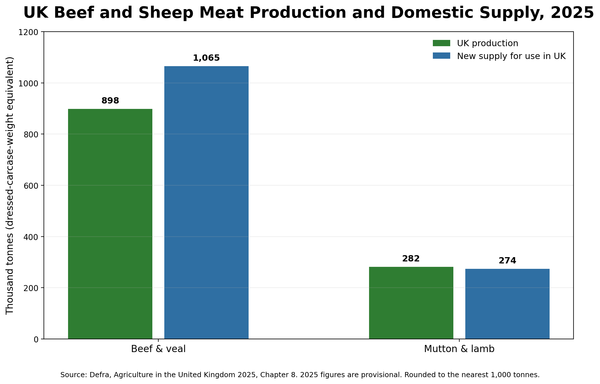
In 2025, the UK produced approximately 898,000 tonnes of beef and veal.
Once imports and exports were included, the total new supply available for use in the UK was approximately 1.065 million tonnes. Domestic production therefore accounted for around 84% of the UK beef and veal market.
That means the UK remained substantially, although not overwhelmingly, dependent on imported beef. The gap between domestic production and the amount required by the UK market was approximately 167,000 tonnes on a net-trade basis.
This does not mean that Britain simply produced 898,000 tonnes and then imported the precise amount it lacked. The UK also exported significant quantities of beef during the year. Imports and exports form part of a much more complicated trade in different cuts, products and markets.
Nevertheless, the basic position is clear: the UK did not produce enough beef and veal to satisfy its own market in 2025.
UK Sheep Meat in 2025
The position for sheep meat was different.
The UK produced approximately 282,000 tonnes of mutton and lamb in 2025. After imports and exports were taken into account, approximately 274,000 tonnes were available as new supply for use within the UK.
Domestic production was therefore equivalent to approximately 103% of the UK market, making the country slightly more than self-sufficient in sheep meat.
This does not remove the need for imports. Sheep meat is imported to meet seasonal demand, supply particular cuts, serve different price points and maintain continuity of supply. At the same time, British lamb—particularly Scotch Lamb and Welsh Lamb—has a strong reputation in export markets.
The UK can therefore be both a net exporter of sheep meat and a significant importer at the same time.
The Import and Export of Beef and Sheep Meat in 2025
International trade is an important part of both sectors.
In 2025, the UK imported approximately 310,000 tonnes of beef and veal on a dressed-carcase-weight-equivalent basis and exported approximately 142,000 tonnes.
This left net beef imports of approximately 168,000 tonnes.
For mutton and lamb, the UK imported approximately 91,000 tonnes and exported approximately 98,000 to 99,000 tonnes. The UK consequently remained a modest net exporter of sheep meat.
These figures help explain what can initially appear to be a contradiction. Britain imports meat even when it produces large quantities of the same product, and it imports sheep meat even though it is more than self-sufficient.
There are several reasons.
Different markets demand different parts of the carcase. Some cuts command a better price overseas, while others are required in greater quantities by British processors, retailers and food-service businesses. Seasonal lamb production also means that imports can help maintain year-round availability.
Price, exchange rates, processing capacity, established supply relationships and the requirements of restaurants and manufactured-food businesses all influence where meat is bought and sold.
Imports and exports should therefore not automatically be regarded as evidence of either a shortage or an unnecessary trade. The more important question is whether the trade takes place under conditions that allow British farmers to compete fairly.
Where Does the UK’s Imported Beef Come From?
Ireland remained by far the largest supplier of imported beef to the UK during 2025. Depending on the precise product categories included, Irish beef accounted for around two-thirds of UK beef imports.
This longstanding relationship is unsurprising. Ireland is geographically close, its production is heavily export-orientated, and the Irish and British beef industries have many similarities.
Irish cattle are individually identified and their movements are recorded through Ireland’s Animal Identification and Movement system. Ireland also operates under EU animal-health, food-safety and veterinary-medicine rules.
It is worth correcting a common misunderstanding here. The European Union’s TRACES system is primarily a veterinary certification and consignment-control platform for international and intra-EU trade. The lifetime records of Irish cattle are held in Ireland’s national identification and movement database, rather than TRACES itself.
Poland, another important supplier, also operates within the EU regulatory framework.
The other leading suppliers in 2025 included Brazil, Australia and New Zealand. Although their individual shares remained much smaller than Ireland’s, imports from Australia and New Zealandgrew rapidly following improved access to the British market under their respective free trade agreements.
This changing supply base deserves attention. Ireland’s dominant position means that most imported beef still comes from a system broadly comparable to that of the UK. However, a growing proportion is arriving from countries with different farm structures, production costs, veterinary rules and animal-welfare requirements.
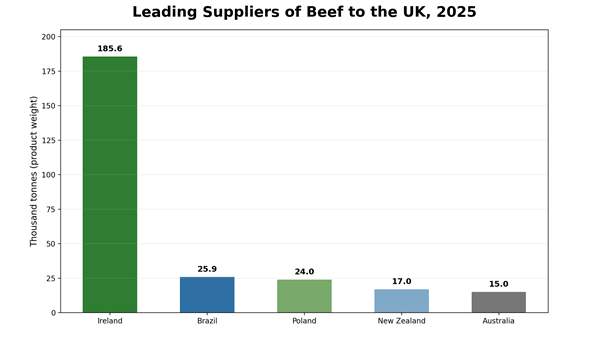
source:-AHDB analysis of HMRC trade Data. Includes fresh, frozen,processed beef and offal.
Does Imported Beef Meet UK Food-Safety Standards?
All meat legally imported into the UK must comply with British import and food-safety requirements.
For example, meat from cattle treated with hormonal growth promoters cannot legally be imported into the UK. The same restriction applies whether the beef comes from the United States, Australia, Brazil or any other country where growth promoters may be permitted domestically.
Imported consignments require the appropriate health certification and may be subjected to documentary, identity and physical checks at border control posts.
That is important, but it does not completely answer the fair-competition question.
Food safety determines whether a product may legally be sold. It does not necessarily mean that the animal was raised under rules identical to those applied on a British farm.
Countries may differ in areas such as:
- * animal-welfare requirements;
- * permitted production systems;
- * transport rules;
- * environmental controls;
- * medicine-recording requirements;
- * traceability arrangements;
- * labour costs;
- * land availability;
- * government support;
- * inspection and enforcement.
Imported meat can therefore be legally compliant with UK food-safety requirements while still having been produced under a different cost and regulatory structure.
The Developing Position on Brazilian Beef
Brazil became an increasingly important supplier of beef to the UK during 2025, although its share remained much smaller than Ireland’s.
A significant development occurred in 2026 when the European Union decided to remove Brazil from the list of countries authorised to export certain animal products to the EU from 3 September 2026.
The decision relates specifically to the EU’s requirements concerning the use of certain antimicrobial medicines in food-producing animals. The European Commission stated that it had not received sufficient guarantees that Brazil would meet the new requirements throughout the lifetime of animals supplying the export chain.
This is not simply a general ban based on a claim that all Brazilian beef is unsafe. It is a regulatory decision concerning whether the necessary evidence and guarantees have been supplied for compliance with particular European antimicrobial rules.
At the time of writing, the UK has not announced that it will automatically impose the same restriction. Indeed, British authorities updated certification arrangements for approved Brazilian beef-exporting states during 2026.
That creates an important question for the UK Government.
If the EU concludes that Brazil has not demonstrated compliance with controls designed to prevent the use of antimicrobials for growth promotion or increased production, will the UK require equivalent guarantees?
Whatever decision is made, the reasoning and evidence should be made public. British farmers are already required to comply with strict medicine rules and have substantially reduced antibiotic use. They are entitled to know that equivalent outcomes are being required of competing imports.
What About Beef from the United States?
The United States was not one of the UK’s five largest beef suppliers in 2025. Actual imports remained very small.
However, the UK–US Economic Prosperity Deal created a duty-free quota allowing up to 13,000 tonnes of qualifying American beef to enter the UK annually.
The agreement does not permit hormone-treated American beef to enter the country. Any US beef imported under the quota must still comply with UK sanitary and food-safety requirements.
The concern for British farmers is therefore not that 13,000 tonnes of hormone-treated beef has suddenly entered the country. It has not.
The concern is the direction of future trade policy.
American beef production includes systems that differ considerably from the typical British model. Large feedlots are a significant part of US cattle finishing, and hormonal growth promoters are lawfully used in parts of the domestic American industry. Only cattle from eligible supply chains meeting British requirements can provide beef for the UK market.
The immediate volume may be modest, but the quota establishes a larger route into the British market. Future governments will face pressure during trade negotiations, and farmers will understandably want firm assurances that existing protections will not be weakened.
The crucial distinction is between granting additional tariff-free access and lowering the standards that imported meat must meet. The former has happened; the latter has not.
Nevertheless, standards only provide confidence when they are clearly stated, independently enforced and not gradually traded away in subsequent negotiations.
What About Imported Sheep Meat?
New Zealand remained the largest overseas supplier of sheep meat to the UK in 2025, with Australia the second-largest.
Together, the two countries supplied the great majority of imported sheep meat. Ireland provided a smaller volume, while countries including Iceland and Spain also supplied parts of the UK market.
The dominance of New Zealand is not new. New Zealand lamb has supplied Britain for generations, helped by its counter-seasonal production and a highly export-focused industry.
Australia increased its presence significantly during 2025. Improved tariff-free access under the UK–Australia Free Trade Agreement, together with weaker demand in some Asian markets, made the UK a more attractive destination for Australian sheep meat.
Both Australia and New Zealand have established livestock traceability and export-certification systems. Australia uses the National Livestock Identification System for cattle, sheep and goats and is expanding individual electronic identification for sheep. New Zealand individually traces cattle and deer through its NAIT system, while sheep movements and animal-status information are recorded through declarations and associated movement systems.
These arrangements are robust, although they are not identical to the systems used in the UK.

source:-AHDB analysis of HMRC trade Data. Includes fresh, frozen,processed sheep meat and offal.
Has the Pattern of Sheep Meat Imports Changed Since 2016?
The most striking feature of the comparison with 2016 is how familiar the list of suppliers remains.
New Zealand was the dominant supplier then and remains so today. Australia, Ireland, Iceland and Spain were also established suppliers.
The principal change is not the arrival of an entirely new group of countries. It is the movement in their relative shares.
Australia has expanded its share, supported by improved market access. Ireland’s contribution has declined, while New Zealand has retained its leading position despite a long-term reduction in its national sheep flock.
AHDB reported that imports of Irish sheep meat fell by approximately 12% during 2025, to around 5,800 tonnes in the period it examined.
The decline appears to have been caused by a combination of factors.
Reduced Irish Production
Ireland’s sheep flock and slaughter numbers have been under pressure, reducing the quantity of lamb available for export.
Strong Alternative Markets
Irish exporters can sell into France, Belgium, Germany and other European markets. When supplies are tight and prices are attractive, the UK is not necessarily the most profitable destination.
Greater Australian Competition
Australian exports to the UK increased substantially during 2025. Expanded tariff-free access and competitive prices enabled Australian suppliers to win a larger share of the market.
New Zealand’s Continuing Importance
New Zealand’s own sheep flock has declined over the longer term, but its export industry remains highly efficient and it continues to supply more sheep meat to the UK than any other overseas country.
sources:- Defra/UK Parliament evidence for the 2016 total; NFU Scotland evidence for New Zealand and Australian volumes; AHDB/HMRC for 2025. 2025 is rounded.
Should British Sheep Farmers Be Concerned?
There is no evidence that imported sheep meat is about to replace British production entirely. The UK remained slightly more than self-sufficient in sheep meat during 2025 and continued to export significant quantities.
However, there are legitimate reasons for farmers to pay close attention.
The tariff-free quotas available to Australia and New Zealand grow over time. Current volumes may remain below the maximum allowed, but considerably more product could enter the UK if currency movements, overseas demand or global production conditions make the British market more attractive.
The effect also depends on what is imported.
A comparatively small quantity of high-value legs, loins or other preferred cuts may affect the domestic market more than a larger tonnage of low-value products. Total tonnage does not always show the full commercial impact.
British sheep farmers also face increasing environmental, animal-welfare, traceability and administrative requirements. Imported products should not be given a cost advantage merely because equivalent outcomes are cheaper or less rigorously enforced in the exporting country.
At the same time, it would be wrong to claim that Australian or New Zealand sheep meat is untraceable or inherently of inferior quality. Both countries have sophisticated export industries, established veterinary controls and recognised traceability systems.
The question is one of equivalence, transparency and cumulative market impact—not a simplistic division between “good British meat” and “bad foreign meat”.
Quality, Traceability and Fair Competition
Traceability does not by itself determine eating quality.
Breed, age, diet, finishing, handling, maturation, processing and cooking all influence the quality of the end product. A traceability database cannot make meat tender or flavoursome.
What traceability provides is confidence.
It allows an animal or consignment to be traced during a disease outbreak, supports the withdrawal of affected products and helps substantiate claims about origin and production.
The UK, the EU, Ireland, Australia and New Zealand all operate substantial traceability arrangements. They differ in their technical design and in whether sheep are traced individually or in groups, but none can reasonably be described as operating without controls.
The greater fair-competition concern lies in the wider package of production requirements and costs.
British farmers should not be expected to meet increasingly demanding environmental, medicine, welfare and record-keeping standards while trade policy steadily increases access for products produced without comparable obligations.
Complete regulatory identity is unrealistic. Different countries have different climates, landscapes and agricultural systems. What should be required is credible equivalence in outcomes, reliable enforcement and honest information for the consumer.
The Net Effect for the UK
The 2025 figures reveal two different markets.
For beef, the UK produced approximately 84% of the amount required by its domestic market. Imports were necessary to fill the gap, although the UK also continued to export beef and beef products.
For sheep meat, the UK produced slightly more than it used domestically. Imports remained commercially important, but the country continued to export a marginally greater amount than it imported.
Imports are therefore not inherently evidence of policy failure. They can balance seasonality, cuts and customer demand.
Nor are exports evidence that imports are unnecessary. A successful livestock economy should be able to sell products into the markets that value them most highly.
The policy concern begins when domestic production contracts while overseas access expands, particularly if British farmers believe they are competing against different regulatory and cost structures.
Conclusion: Are British Farmers Competing on a Level Playing Field?
There is no single answer covering every imported product or every supplying country.
Most UK beef imports still come from Ireland, whose regulatory, animal-health and traceability systems are broadly comparable to those of the UK. Poland also operates within the EU framework.
Australia and New Zealand have robust traceability and export-control systems, although their farm structures, climates, costs and some production rules differ from those in Britain.
Brazil presents more immediate regulatory questions because of the European Union’s decision concerning antimicrobial-use guarantees.
The United States currently supplies very little beef to the UK, but its new tariff-free quota has raised understandable questions about the direction of future trade negotiations.
The debate should therefore not be reduced to whether imported meat is either acceptable or unacceptable.
The more useful questions are:
- * Is the meat safe and fully traceable?
- * Are equivalent animal-health and medicine controls enforced?
- * Are animal-welfare outcomes genuinely comparable?
- * Are environmental obligations being considered?
- * Is the product’s origin clear to the customer?
- * Are trade concessions being assessed for their cumulative effect on UK production?
- * Can British farmers remain economically viable while meeting the standards required of them?
The UK is not fully self-sufficient in beef and will continue to require imports. It is slightly more than self-sufficient in sheep meat, but international trade will remain an important part of that market as well.
The objective should not be to end trade. It should be to ensure that trade complements a strong domestic livestock sector rather than gradually replacing it.
British farmers can compete with imported meat, but only if the rules, costs and expectations applied to every supplier produce genuinely comparable outcomes.
Statistical note: The principal production, trade and self-sufficiency figures are from Defra and are expressed as dressed-carcase-weight equivalents. Some country-of-origin figures from AHDB are expressed as product weight and may include fresh, frozen and processed meat and offal. Figures from the two measurement systems should not be directly added together.
Frequently Asked Questions
How self-sufficient was the UK in beef in 2025?
The UK produced approximately 84% of the beef and veal required by its domestic market in 2025. Imports were therefore needed to make up the difference between domestic production and total UK supply.
Was the UK self-sufficient in sheep meat in 2025?
Yes. UK sheep-meat production was equivalent to approximately 103% of domestic supply in 2025. The UK produced slightly more lamb and mutton than it used domestically, although it continued to import and export substantial quantities.
Why does the UK import beef when it already produces so much?
The UK does not produce enough beef to meet total domestic demand. Imports also help supply particular cuts, maintain year-round availability and meet the requirements of retailers, restaurants and food manufacturers. At the same time, some British beef is exported to markets where it attracts a higher value.
Why does the UK import lamb when it produces more than it consumes?
Sheep-meat trade is influenced by seasonality, consumer demand and the value of different cuts. British lamb may be exported to overseas markets while imported lamb helps maintain supply at other times of the year or provides cuts required by UK buyers.
Which country supplies the most imported beef to the UK?
Ireland is by far the largest supplier of beef to the UK. Its proximity, established trade links and broadly comparable livestock, veterinary and food-safety regulations make it a natural source for the British market.
Which countries supply most of the UK’s imported sheep meat?
New Zealand is the largest supplier of imported sheep meat to the UK, followed by Australia. Ireland and several European countries also supply smaller quantities.
Does imported beef and lamb have to meet UK food-safety standards?
Yes. Meat legally imported into the UK must meet British food-safety and import requirements. For example, beef from cattle treated with prohibited hormonal growth promoters cannot legally be sold in the UK.
However, compliance with UK food-safety rules does not necessarily mean that every part of the animal’s production system was identical to the rules applying on a British farm.
Are imported livestock products produced to the same standards as British meat?
Standards vary by country. Ireland and EU countries generally operate under regulatory systems broadly comparable to those of the UK. Australia and New Zealand have well-established traceability and veterinary systems, although their farm structures and some production rules differ.
The most important question is whether imported products achieve genuinely equivalent outcomes in food safety, animal health, welfare, traceability and medicine controls.
Is imported meat fully traceable?
Meat imported legally into the UK must come through approved supply chains with veterinary certification and traceability documentation. The precise tracing system differs between countries, but major suppliers including Ireland, Australia and New Zealand operate established national livestock-recording systems.
Are British livestock farmers competing on a level playing field?
Not necessarily in every respect. Imported meat may comply with UK food-safety requirements while being produced under different environmental, labour, welfare and administrative conditions.
Fair competition does not require every country to use identical farming systems, but British farmers should not be placed at a disadvantage by having to meet costs and obligations that are not reflected in the standards applied to competing imports.
Explore the Cattle Software |
Explore the Sheep Software |
View Pricing
← Back to Farm Insights Blog