UK Livestock Greenhouse Gas Emissions: Understanding CO₂, Methane and Nitrous Oxide
Published July 2026
The cycle can be summarized as follows:
- Plants capture CO₂ from the atmosphere via photosynthesis.
- Livestock consume plants, transferring carbon into their bodies.
- Rumen microbes ferment carbohydrates, producing VFAs, H₂, and CO₂.
- Methanogens convert H₂ and CO₂ into CH₄, which is released into the atmosphere.
- CO₂ is respired by the animal and eventually returns to the atmosphere.
- Humans consume livestock products, and the carbon in these products is also eventually respired as CO₂
This cycle is mostly balanced, as the CO₂ emitted by livestock is largely derived from recently captured atmospheric carbon in plants. However, methane emissions add a short-term climate forcing effect because of their high global warming potential and relatively short atmospheric lifespan (~12 years), making livestock a significant contributor to near-term climate change
CO2e, or carbon dioxide equivalent, is a standard metric used to compare the global warming impact of different greenhouse gases by expressing them in terms of the amount of CO2 that would produce the same warming effect.
Definition and Purpose
CO2e stands for carbon dioxide equivalent. It is used in climate science and environmental reporting to quantify the total greenhouse gas (GHG) emissions from an activity, product, or entity, regardless of the specific gases involved. Since different GHGs have different warming potentials, CO2e provides a common unit to compare their climate impacts effectively.
How CO2e is Calculated
The calculation of CO2e involves multiplying the mass of each greenhouse gas emitted by its Global Warming Potential (GWP) over a specified time horizon (usually 100 years) and summing them all:
CO2e=(mass of CO2×1)+(mass of CH4×28)+(mass of N2O×265)+…
The GWP values are periodically updated by organizations like the Intergovernmental Panel on Climate Change (IPCC) to reflect improved climate science data.
What UK agriculture actually emits.
The latest final figures cover 2024:
Total UK greenhouse gas emissions were 373.4 million tonnes of CO₂ equivalent.
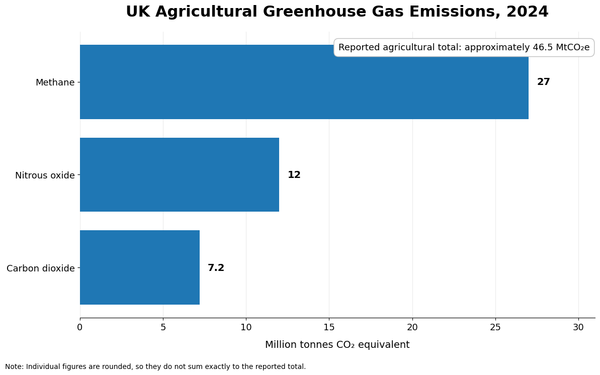
Agriculture produced 46.5 million tonnes, approximately 12.5% of the UK total. The main DESNZ report rounds this to 12%, while Defra describes it as “around 13%”.
Within agriculture, approximately:
- 58% was methane
- 26% was nitrous oxide
- 15–16% was carbon dioxide
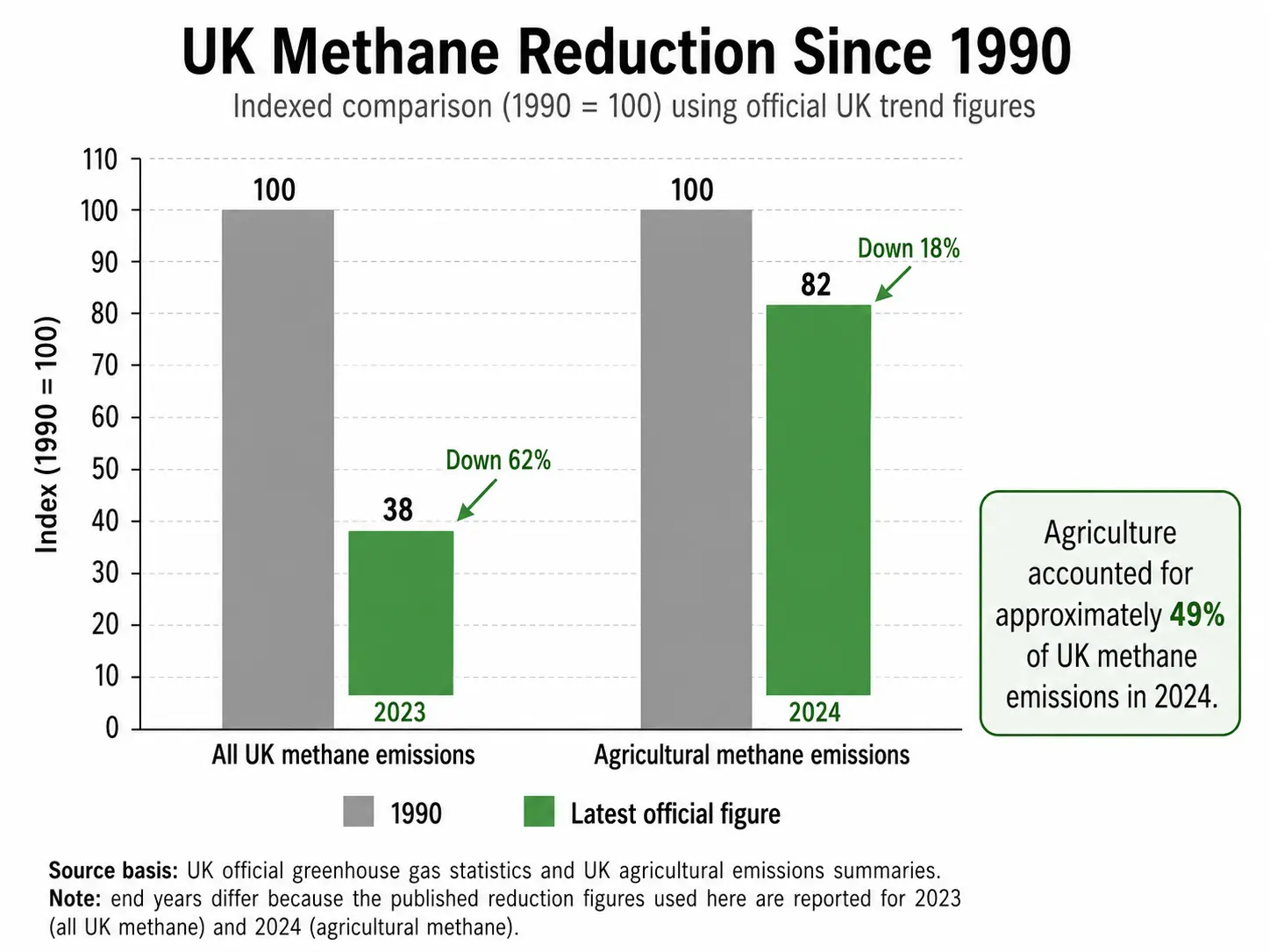
Agriculture produced 49% of all UK methane, 59% of all UK nitrous oxide, but only 2.5% of UK carbon dioxide emissions.
Agricultural emissions were 15% lower than in 1990. Agricultural methane was down approximately 18% and nitrous oxide approximately 26%, mainly because of falling livestock numbers and reduced synthetic fertiliser use.
Agriculture is not exactly the same as livestock
The official agriculture total includes livestock digestion, manure management, agricultural soils, machinery and on-farm fuel combustion. It does not provide one simple figure covering “livestock farming” alone because some nitrous oxide from soils and fertiliser may support either livestock or crop production.
Livestock nevertheless dominates agricultural methane. In the UK Government’s 2025 Methane Action Plan, cattle were responsible for 78% of agricultural methane in 2023, with sheep contributing another 17%. Approximately 65% came from cattle digestion and 12% from cattle manure management
The most recent verified statistcs at the time of writing
The Ubiquitous Environmentalist vs Reality
The entirety of the Agricultural Industry contributes a total of around 0.6% towards the GDP (gross domestic product) of the UK whilst at the same time contributing around 12.5% of the GHG (greenhouse gas) emissions.
Comparing agriculture’s 0.6% economic contribution to its 12.5% share of GHG emissions directly and definitively has long been debated by economists, environmental scientists and policymakers. It is a topic I’ve seen argued back and forth again and again: the answer is in the way you choose to measure it. The argument can be divided into two distinct lenses.
The Enviromentalist Argument
Climate science and environmental economists believe that the comparison is entirely valid and necessary to highlight systemic market failures:
- True Cost (Negative Externalities): In traditional economics, GVA is about production value and ignores environmental damage. The comparison is fair to show that there is a huge imbalance between private profit and public cost. The agricultural sector in the UK generates less than 1% of GDP, so it is responsible for an eighth of the climate damage.
- Resource and Land Monopoly:UK agriculture uses somewhere between 69% and 70% of the UK's total land area. From an environmental efficiency perspective, using nearly 70% of a country’s land to generate 0.6% of its wealth and generate 12.5% of its emissions is arguably a very high carbon footprint.
- Policy Disincentives:Agricultural emissions have flatlined (so not falling as fast as in other industries) since 2008, which indicates that agriculture has lagged behind.
Why the Comparison is Seen as Unfair (The Structural View)
Critics of a direct percentage-to-percentage comparison argue it oversimplifies the unique role agriculture plays in society,(a view that anyone involved with farming would agree with, including me the author) distorting the true picture for several reasons:
- Essential Life Support vs. Discretionary GVA: Comparing farming to sectors like finance or digital services is fundamentally flawed. If the financial sector were to disappear, the economy of course would suffer; however if agriculture disappears, then society starves. Gross Value Added (GVA) measures monetary market exchange, it does not measure existential human value.
- The "Sector Leakage" Paradox: Agriculture sits at the absolute base of the supply chain. While raw farming is valued at 0.6% of GVA, it of course underpins the entire UK agri-food sector, which contributes 6.2% of national GVA (£162.3 billion) and secures the domestic food supply.
- Biological vs. Industrial Emissions: Unlike transport or energy which emits carbon dioxide (CO2) by burning fossil fuels, agricultural emissions are predominantly driven by mostly unavoidable biological processes. Ruminant livestock naturally produce methane (CH4), and soil cultivation releases nitrous oxide (N2O). These cannot be simply switched off with a transition to renewable electricity or by any other means.
- Distorting Success by Decarbonisation: Farming emissions have actually fallen by over 17% since 1990. However, its relative share of emissions looks worse (rising to ~13%) purely because other sectors, like the UK electricity grid, have decarbonized at a much faster rate. This can easily be misconstrued by headlines "agriculture emissions now higher than those of energy production", as have been reported in the press.
Why animal respiration is part of the carbon cycle
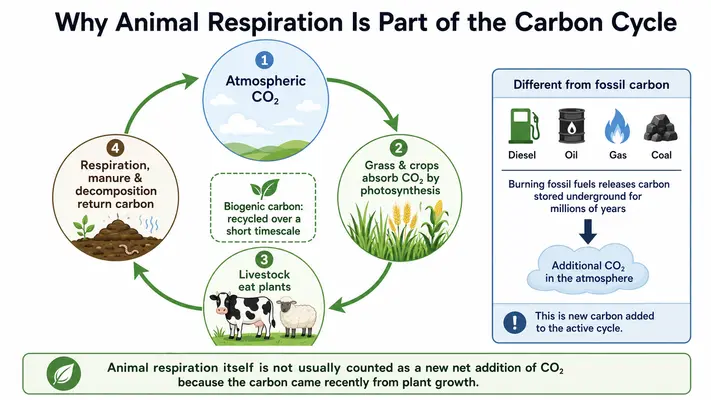
Cattle and sheep breathe out carbon dioxide, just as people and other animals do. However, this carbon dioxide is part of a relatively short biological carbon cycle and is different from the carbon dioxide released by burning coal, oil or gas.
Grass and other plants absorb carbon dioxide from the atmosphere through photosynthesis. They use the carbon to produce leaves, stems and roots. Livestock then consume some of this plant material, and part of the carbon is returned to the atmosphere through respiration. The remainder is returned through manure, urine and the eventual decomposition of plant and animal material.
The cycle can be simplified as:
Atmospheric carbon dioxide → plant growth → animal feed → animal respiration and manure → atmospheric carbon dioxide → new plant growth
The carbon breathed out by an animal was therefore removed from the atmosphere comparatively recently by the plants it ate. Provided that the grassland or crop is replaced and continues growing, this carbon can be absorbed again. For this reason, carbon dioxide from normal livestock respiration is not generally counted as a new addition to atmospheric carbon dioxide in national greenhouse gas inventories.
This is very different from fossil-fuel emissions. When diesel, petrol, coal or natural gas is burned, carbon that has been stored underground for millions of years is released into the atmosphere. This introduces additional carbon into the active carbon cycle. Because carbon dioxide can remain within the climate system for a very long time, continued fossil-fuel use causes atmospheric carbon dioxide to accumulate.
The natural carbon cycle does not mean that livestock farming is automatically carbon neutral. Farms may still produce fossil carbon dioxide through machinery, transport, electricity, heating, fertiliser manufacture and purchased feed. Carbon can also be lost when soils are cultivated, peat is drained, woodland is cleared or permanent grassland is damaged.
Well-managed grassland, hedgerows, trees and soils can retain substantial stores of carbon, and depleted soils may be able to absorb additional carbon when management improves. However, this storage should not automatically be assumed to cancel all continuing farm emissions. Soil carbon can eventually reach a new balance, and it can be released again if land management changes.
Animal respiration itself is therefore not the main carbon dioxide concern associated with livestock production. The more important issues are fossil-energy use, changes in soil and vegetation carbon, methane from digestion and manure, and nitrous oxide arising from nitrogen in soils and manures.
Why biogenic does not mean harmless
The word biogenic simply means that something has been produced by living organisms or biological processes. In livestock farming, methane is produced mainly during the digestion of feed by cattle and sheep, with further emissions arising from stored manure and slurry.
The carbon contained in this methane originally came from atmospheric carbon dioxide absorbed by grass and other plants. In that sense, livestock methane is part of the biological carbon cycle rather than a new source of fossil carbon. However, describing methane as biogenic explains where its carbon came from; it does not mean that the methane has no effect on the climate.
Methane is a powerful greenhouse gas. While it remains in the atmosphere, it absorbs heat much more strongly than the same mass of carbon dioxide. The IPCC estimates that methane has an average atmospheric lifetime of approximately 11.8 years, although individual methane molecules are continually being created and removed rather than all disappearing after a fixed period.
Most atmospheric methane is eventually broken down through chemical reactions and converted largely into carbon dioxide and water. In the case of livestock methane, the resulting carbon dioxide remains part of the relatively short biological carbon cycle. Nevertheless, warming has already occurred during the years in which the carbon existed in the atmosphere as methane.
This means that two statements can both be correct:
Livestock methane does not add ancient fossil carbon to the atmosphere.
Livestock methane still contributes to global warming while it is present.
The difference between methane and fossil carbon dioxide lies largely in how the gases behave over time. Carbon dioxide accumulates when it continues to be emitted. Each additional release from coal, oil or gas adds more carbon to the atmosphere, and much of its warming influence persists for a very long time.
Methane is shorter-lived and does not accumulate in exactly the same way. If methane emissions remain broadly stable over a long period, the amount being removed from the atmosphere eventually becomes approximately equal to the amount being emitted. The methane concentration — and the warming associated with it — can then become relatively stable rather than continuing to rise indefinitely.
However, stable methane emissions are not the same as zero climate impact. They maintain an increased methane concentration and continue the warming already caused by those emissions.
Changes in the rate of methane emissions are therefore especially important:
Increasing methane emissions add further methane to the atmosphere and cause additional warming.
Broadly stable emissions maintain approximately the existing methane-related warming after an adjustment period.
Falling methane emissions reduce atmospheric methane concentrations and can reduce methane’s contribution to warming.
This is one reason why reducing methane can have a comparatively rapid climate benefit. The IPCC concludes that substantial methane reductions can lower peak warming and reduce the likelihood of exceeding climate targets.
It would therefore be misleading either to treat livestock methane as identical to fossil carbon dioxide or to dismiss it because it is natural. Methane from wetlands, wildlife, waste, fossil-fuel extraction and livestock is still methane once it reaches the atmosphere. Its warming effect is determined by the properties of the gas, not simply by whether its source was natural, agricultural or industrial.
The practical objective should not be to portray cattle and sheep as unnatural sources of carbon. Ruminants have always produced methane as part of their digestion. The relevant questions are whether livestock methane emissions are rising, stable or falling, and how avoidable emissions can be reduced while maintaining food production.
Measures such as improved animal health, better fertility, good-quality forage, efficient growth and finishing, careful ration formulation and improved manure management can reduce methane emissions per unit of food produced. Some measures may also reduce total farm methane emissions. The UK Government recognises agricultural methane as an important target and reports that cattle account for the majority of UK agricultural methane emissions.
Biogenic methane is therefore neither equivalent to fossil carbon dioxide nor harmless. It is recycled biological carbon passing temporarily through a powerful greenhouse gas. Recognising both sides of that explanation provides a more accurate foundation for considering how livestock methane should be measured and reduced.
What methane’s 12-year lifetime really means
Methane is often described as having a 12-year cycle. A more accurate description is that methane has an average atmospheric lifetime of about 12 years. The Intergovernmental Panel on Climate Change estimates that methane has an atmospheric perturbation lifetime of approximately 11.8 years, with an uncertainty range of 1.8 years either side.
Methane molecules are being added to and removed from the atmosphere continuously. Most methane is removed through chemical reactions involving hydroxyl radicals in the atmosphere. Smaller amounts are removed through soils and other processes. The 12-year figure therefore describes the average behaviour of atmospheric methane as a whole; it is not a fixed expiry date for each individual molecule.
Short-lived does not mean short-lived warming is unimportant
Methane is described as a short-lived greenhouse gas because it remains in the atmosphere for much less time than carbon dioxide. However, while methane is present, it is very effective at trapping heat.
This means that a release of methane has a relatively strong warming effect in the first few decades after it is produced. As the methane is gradually removed, that further warming effect decreases.
Carbon dioxide behaves differently. Some of the carbon dioxide released today will remain in the climate system for hundreds or thousands of years. Continued fossil-fuel emissions therefore accumulate the carbon dioxide, which will generate more warming as long as net emissions continue.
Methane doesn’t accumulate over time in the same manner. And that effect is especially important if the annual rate of emissions is increasing, or is relatively stable or decreasing.
Increasing methane emissions
When annual methane emissions rise, more methane is entering the atmosphere than is being removed. Atmospheric methane concentrations increase and additional warming occurs.
This is similar to filling a bath faster than water can escape through the plughole. The water level rises because the inflow exceeds the outflow.
If livestock numbers increase, emissions per animal rise, or manure produces more methane, the additional emissions can increase methane concentrations and add to warming.
Stable methane emissions
When methane emissions remain at approximately the same level for a sufficiently long period, the amount being removed from the atmosphere can become broadly similar to the amount being added.
Under these circumstances, atmospheric methane concentrations and the warming attributed to those emissions can become approximately stable. The emissions continue, but they no longer produce the same steadily increasing warming effect associated with continued carbon dioxide emissions. The IPCC’s comparison of methane and carbon dioxide emissions illustrates that the temperature response to a sustained increase in methane emissions rises initially and then approaches a comparatively stable level.
This does not mean that stable methane emissions have no climate effect. They maintain a higher atmospheric methane concentration and continue the warming produced by that concentration.
A useful distinction is therefore:
Stable methane emissions may cause little additional warming after an adjustment period, but they maintain the methane-related warming already created.
This is an important difference from fossil carbon dioxide. Stable annual carbon dioxide emissions continue adding carbon to the atmosphere, whereas stable methane emissions can eventually be approximately balanced by methane removal.
Falling methane emissions
When methane emissions decline, less methane enters the atmosphere while existing methane continues to be removed. Atmospheric methane concentrations can then fall, reducing methane’s contribution to warming.
This gives methane reduction a potentially important near-term climate benefit. The UK Government describes methane reduction as one of the quickest ways of reducing the rate of warming because of the gas’s relatively short atmospheric lifetime.
A sustained reduction in livestock methane emissions could therefore do more than slow the growth of emissions. Depending on the scale and duration of the reduction, it could reduce the warming attributed to livestock methane.
However, this should not be interpreted as cancelling warming from accumulated fossil carbon dioxide. Reducing methane and reducing carbon dioxide perform different but complementary roles. Methane reductions can limit near-term warming, while carbon dioxide emissions must reach net zero to prevent their continuing accumulation.
Why the starting point matters
The climate effect of livestock methane cannot be understood from one year’s emissions figure alone. It is also necessary to know how emissions have changed over time.
Two livestock sectors could report identical annual methane emissions but have different effects on current warming:
A sector whose methane emissions are rising is adding further warming.
A sector whose emissions have been stable for many years may be maintaining broadly stable methane-related warming.
A sector whose emissions are falling may be reducing its contribution to warming.
This is why historical livestock numbers, productivity, manure management and methane-emission trends matter when assessing the climate effect of UK livestock farming.
UK methane emissions from all sectors fell by 62% between 1990 and 2023 (The UK Methane Action Plan reports that cattle produced 78% of UK agricultural methane emissions in 2023, including emissions from digestion and manure management.), with reductions occurring in fuel supply, waste and agriculture. Agricultural methane has also declined over the longer term, partly because of reduced cattle and sheep populations and changes in farming practices.
Measuring methane alongside other gases
National greenhouse gas inventories normally combine methane, nitrous oxide and carbon dioxide using 100-year Global Warming Potential, commonly known as GWP100. This produces the familiar carbon-dioxide-equivalent figure, or CO₂e.
GWP100 is useful for comparing gases and reporting total emissions, but one combined figure cannot fully show the different ways in which short-lived methane and long-lived carbon dioxide affect temperature over time.
Alternative approaches, including GWP*, have been developed to give greater emphasis to changes in the methane emission rate. These can help illustrate the difference between rising, stable and falling methane emissions. However, they do not make methane harmless and do not replace the official emissions figures.
For a general farming discussion, the most important point is simpler than the debate over emissions metrics:
Methane’s average lifetime of around 12 years means that reducing emissions can produce a relatively rapid climate benefit. It does not mean that methane has no warming effect, nor that emissions can be ignored because they form part of a biological cycle.
The practical objective for UK livestock farming is therefore to prevent methane emissions from rising and to achieve realistic, lasting reductions through better animal health, fertility, feeding, productivity and manure management. These improvements can reduce avoidable methane while allowing cattle and sheep production to continue contributing food, employment and environmental management.
Why nitrous oxide deserves more attention
Methane receives much of the public attention surrounding livestock emissions, largely because of the methane produced during cattle and sheep digestion. Nitrous oxide is discussed less frequently, yet it is a powerful and long-lived greenhouse gas and represents a substantial part of UK agricultural emissions.
According to Defra’s latest UK agricultural emissions figures , agriculture accounted for 59% of all UK nitrous oxide emissions in 2024. Agricultural nitrous oxide emissions were approximately 12 million tonnes of carbon dioxide equivalent.
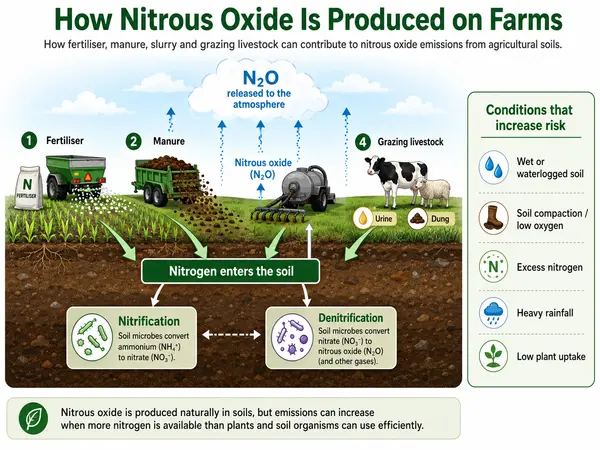
The majority of agricultural nitrous oxide emissions come from soils, particularly following nitrogen fertiliser use, manure applied to land, urine and dung deposited by grazing animals, and nitrogen lost through leaching or run-off.
A powerful and long-lived greenhouse gas
Nitrous oxide behaves differently from the relatively short-lived methane discussed in the previous section. The Intergovernmental Panel on Climate Change estimates that an increase in atmospheric nitrous oxide has a lifetime of approximately 109 years. It therefore remains in the atmosphere for around a century, allowing continuing emissions to add to its atmospheric concentration.
Using the standard 100-year comparison, the IPCC gives nitrous oxide a Global Warming Potential of approximately 273. This means that, kilogram for kilogram, an emission of nitrous oxide has around 273 times the warming effect of the same mass of carbon dioxide over that period.
This does not mean that every kilogram of nitrogen fertiliser or manure becomes nitrous oxide. Only a relatively small proportion of the nitrogen is emitted in this form. However, because nitrous oxide is so powerful and remains in the atmosphere for so long, comparatively small losses can have a significant climate effect.
Unlike biogenic methane, nitrous oxide cannot be described as part of a short atmospheric cycle that reaches a broadly stable warming effect when emissions remain constant. Continuing nitrous oxide emissions add to its atmospheric concentration and contribute further warming.
Nitrous oxide also affects the stratospheric ozone layer. The World Meteorological Organization’s information on nitrous oxide explains that it acts as a strong greenhouse gas in the lower atmosphere and as an ozone-depleting substance in the stratosphere.
How nitrous oxide is produced on farms
Nitrous oxide is not released simply because nitrogen is present. It is produced mainly by naturally occurring soil microorganisms as they convert nitrogen between different chemical forms. Defra’s background information on agricultural greenhouse gas emissions identifies nitrification and denitrification as the principal biological processes involved.
Two important biological processes are involved:
- Nitrification, in which ammonium nitrogen is converted into nitrate.
- Denitrification, in which nitrate is converted into gases under conditions where oxygen is limited.
These are natural soil processes, but emissions can increase when more available nitrogen is present than plants and soil organisms can use effectively.
The conditions favouring nitrous oxide production vary, but emissions are often more likely when:
- Soils are wet or waterlogged.
- Soil is compacted and poorly aerated.
- Nitrogen is applied when there is little active plant growth.
- Fertiliser or manure applications exceed crop requirements.
- Slurry or manure is applied before heavy rainfall.
- Large quantities of urine are deposited in concentrated patches.
- Nitrogen is lost through leaching or run-off.
The actual amount produced can vary considerably according to soil type, temperature, moisture, drainage, crop growth and the timing and form of nitrogen applications. The UK Government acknowledges that estimates of agricultural nitrous oxide carry considerable uncertainty because emissions vary greatly across locations and over time.
The connection with livestock farming
Nitrous oxide is not solely a manufactured-fertiliser issue. Livestock systems contribute nitrogen through:
- Manure and slurry applied to land.
- Urine and dung deposited directly by grazing animals.
- Nitrogen lost during manure storage and handling.
- Fertiliser used to grow grass and forage crops.
- Purchased feed containing nitrogen that is not retained in animal growth, milk or other production.
Protein contains nitrogen. Animals require protein for health and production, but nitrogen consumed in excess of their requirements is largely excreted. This nitrogen can remain a useful fertiliser resource if it is stored, applied and used effectively. If poorly managed, however, it can be lost as ammonia, nitrate or nitrous oxide.
Reducing nitrous oxide is therefore closely linked to improving nitrogen-use efficiency: retaining more nitrogen in useful plant and animal production while losing less to the wider environment.
Why nitrogen efficiency matters
Nitrogen losses represent more than a greenhouse gas problem. Nitrogen that escapes as nitrous oxide, ammonia or nitrate is no longer available to support useful grass, crop or animal production. Defra’s information on effective nutrient management explains that improved nutrient use can help reduce greenhouse gas emissions and water pollution while increasing productivity and reducing input costs.
The same nitrogen can move through several environmental pathways. Defra’s Code of Good Agricultural Practice explains that surplus or poorly timed nitrogen applications can result in losses as ammonia or nitrous oxide to the air and nitrate to water.
Good nitrogen management must therefore consider the whole system. A change that reduces one type of loss may sometimes increase another if it is applied without considering soil, weather and crop conditions. For example, retaining more nitrogen within slurry can increase its fertiliser value, but that nitrogen must then be applied at the correct rate and time if subsequent losses are to be avoided.
Practical ways to reduce nitrous oxide emissions
Many of the measures that can reduce avoidable nitrous oxide emissions are also recognised as good nutrient-management practice. Detailed guidance on soil testing, manures, fertilisers and crop requirements is available in the AHDB Nutrient Management Guide (RB209).
- Test soils regularly and maintain an appropriate pH.
- Analyse slurry and manure wherever practical.
- Account for the available nutrients contained in organic manures.
- Match nitrogen applications to realistic grass and crop requirements.
- Apply nitrogen when plants are actively growing and able to use it.
- Avoid spreading onto waterlogged, frozen or heavily compacted soils.
- Avoid applying nitrogen immediately before forecast heavy rainfall.
- Calibrate fertiliser and manure-spreading equipment.
- Improve soil structure and reduce compaction.
- Maintain drainage where this is environmentally appropriate.
- Use clover and other legumes to reduce dependence on manufactured nitrogen where conditions allow.
- Improve livestock feed and protein efficiency.
- Use suitable fertiliser products, application methods or inhibitors where evidence, economics and regulations support them.
There is no single measure that will remove all nitrous oxide emissions. Some emissions arise naturally whenever nitrogen cycles through agricultural soils. The practical objective is to reduce the quantity of surplus nitrogen that remains vulnerable to loss.
Better records can support better nitrogen management
Reliable farm records can make nitrogen management more precise. Useful information includes:
- Livestock numbers and time spent grazing.
- Manure and slurry production.
- Storage capacity and spreading dates.
- Fields receiving manure or fertiliser.
- Application rates.
- Soil and manure test results.
- Grass and crop yields.
- Purchased fertiliser and feed use.
These records can help identify whether nitrogen inputs are producing useful output or being lost. They can also support nutrient-management planning, regulatory compliance and future environmental reporting.
Nitrous oxide deserves more attention because it combines several difficult characteristics. It is powerful, remains in the atmosphere for around a century and is generated through complex biological processes that are not immediately visible on the farm.
The positive aspect is that nitrous oxide is also closely connected to resource efficiency. Better use of fertiliser, manure, slurry, soil and livestock feed can reduce avoidable emissions while improving nutrient value and, in some cases, reducing farm costs.
The objective should not be to eliminate nitrogen from livestock farming. Nitrogen is essential for growing grass, crops and animals. The challenge is to use it as efficiently as possible and prevent valuable nutrients from becoming costly environmental losses.
Practical measures already available to farms
There is no single technology or management change capable of removing all greenhouse gas emissions from livestock farming. Methane and nitrous oxide are produced through biological processes that cannot be eliminated completely while cattle, sheep, grass and crops continue to be produced.
There are, however, many practical measures that can reduce avoidable emissions. The Climate Change Committee’s research into greenhouse gas abatement in UK agriculture examined 29 measures covering livestock health, feeding, breeding, faster beef finishing, manure management and the management of grassland and arable soils.
Not every measure will suit every farm. A housed dairy herd, an intensive beef-finishing unit and an extensive hill sheep flock have very different opportunities and constraints. The most effective approach is generally to identify where animals, feed, nutrients and energy are being used inefficiently and then select measures appropriate to that particular system.
Improving animal health and fertility
Healthy animals generally make more efficient use of feed and are more likely to reach their productive potential. Disease, infertility, poor growth, mortality and premature culling all consume feed and other farm resources without producing the expected quantity of milk, meat or breeding output.
The UK Methane Action Plan identifies better animal health and welfare as an important means of preventing waste, improving productivity and reducing livestock emissions. Practical actions may include:
- Working with a vet to maintain a herd or flock health plan.
- Monitoring and controlling endemic diseases.
- Improving biosecurity and vaccination programmes where appropriate.
- Recording fertility, calving and lambing performance.
- Reducing avoidable mortality and premature culling.
- Investigating animals that repeatedly fail to meet growth targets.
- Improving youngstock health, colostrum management and early growth.
Better health does not necessarily reduce the methane produced by every animal on every day. Its principal benefit is that a greater proportion of the feed, methane and other resources associated with the herd or flock results in useful production.
Improving growth and finishing performance
An animal that takes longer than necessary to reach its finishing target continues consuming feed and producing methane and manure throughout the additional period. Reducing unnecessary finishing days can therefore lower emissions per kilogram of beef produced, while potentially reducing feed, housing and labour costs.
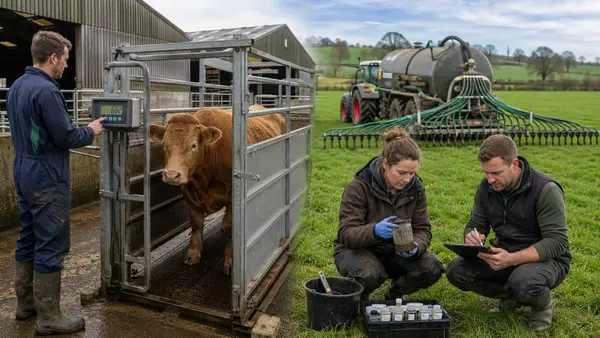
AHDB’s guidance on finishing beef cattle earlier to reduce emissions identifies genetics, nutrition and health as the three main areas through which finishing performance can be improved.
The objective should not simply be to push animals to finish as quickly as possible. Cattle must still meet the required weight, fat class and carcase specification without compromising health, welfare or farm profitability. Useful actions include:
- Weighing cattle regularly and comparing performance with target growth rates.
- Identifying groups or individual animals falling behind.
- Testing forage and adjusting diets where growth is below target.
- Investigating disease, parasites or other health problems affecting performance.
- Comparing finishing age and performance by breed, sire, source and management group.
- Using purchase and abattoir records to calculate liveweight gain, carcase performance and margin.
Improving forage quality and feed efficiency
Feed production and digestion are closely connected to methane, nitrous oxide and carbon dioxide emissions. Better feed efficiency means obtaining more useful animal output from the feed and nutrients already being used.
This does not necessarily mean feeding more concentrate. It may involve producing more digestible grass and forage, reducing storage losses, analysing silage, balancing rations more accurately and matching feed to the animal’s age and stage of production.
AHDB’s guidance on nutritional strategies for reducing livestock emissions explains that precision feeding can improve feed conversion while avoiding the unnecessary overfeeding of energy and protein.
Avoiding excessive dietary protein is particularly relevant to nitrous oxide. Animals require protein, but nitrogen supplied beyond their needs is largely excreted in urine and manure. That surplus nitrogen may subsequently be lost as ammonia, nitrate or nitrous oxide.
Practical feeding measures may include:
- Analysing silage, hay and other conserved forage.
- Matching rations to realistic production and growth targets.
- Improving grassland management and forage digestibility.
- Avoiding unnecessary overfeeding of protein.
- Monitoring feed intake, growth, milk output and body condition.
- Reducing spoilage and losses during forage harvesting and storage.
- Seeking advice from a nutritionist where diets are complex.
Methane-suppressing feed products
Some feed products can directly reduce the methane produced during cattle digestion. According to the UK Methane Action Plan , different methane-suppressing feed products may reduce enteric methane by approximately 5% to 30% per cow, depending on the product and circumstances.
These products may offer a useful additional measure, particularly where cattle receive a controlled daily ration. Their effectiveness and practicality will depend on the farming system, the product, the diet, cost and the ability to provide the correct amount consistently.
Only products that have been properly assessed and authorised should be used, and feed additives should not be viewed as a substitute for animal health, forage quality, fertility and general feed efficiency. They are one possible tool within a broader emissions plan rather than a complete solution by themselves.
Breeding for efficient and resilient livestock
Breeding decisions influence the performance of a herd or flock for many years. Traits connected with growth, fertility, maternal performance, longevity, health and feed efficiency can all affect the resources required to produce a kilogram of meat or litre of milk.
AHDB’s guidance on breeding to reduce emissions in beef cattle explains how breeding goals that improve efficiency can also reduce emissions per unit of production.
Breeding should remain balanced. Selecting for one trait alone can create unwanted consequences elsewhere. Estimated breeding values and other performance information should therefore be considered alongside soundness, calving ease, fertility, health, longevity and suitability for the farm’s production system.
Managing manure and slurry more effectively
Methane can be produced when manure or slurry decomposes in conditions where little oxygen is present. Nitrogen can also be lost from manure as ammonia, nitrate or nitrous oxide. Storage and application practices therefore influence several different environmental losses.
Useful measures include:
- Providing sufficient storage to avoid spreading in unsuitable conditions.
- Keeping unnecessary rainwater out of slurry systems.
- Covering suitable slurry stores.
- Maintaining stores to prevent leaks and uncontrolled releases.
- Testing slurry or using reliable standard nutrient values.
- Applying manure when crops and grass can make effective use of its nutrients.
- Using appropriate low-emission spreading equipment.
- Accounting for manure nutrients before purchasing manufactured fertiliser.
- Considering anaerobic digestion where it is technically and economically suitable.
The UK Methane Action Plan reports that more than £100 million has been allocated through England’s Slurry Infrastructure Grant, with funded stores requiring methane-mitigating impermeable covers. Current information on the England-only scheme is available in the Slurry Infrastructure Grant guidance .
Manure management must be considered as a complete system. Retaining more nitrogen in a slurry store can increase its fertiliser value, but the nitrogen must then be applied at an appropriate rate and time. Otherwise, a reduction in one form of pollution may simply move the nitrogen into another loss pathway.
Using fertiliser and manure nitrogen more accurately
Reducing nitrous oxide is closely connected to making better use of nitrogen. The objective is to supply enough nitrogen for healthy grass and crop growth without leaving a large surplus vulnerable to loss.
The AHDB Nutrient Management Guide, RB209 provides detailed guidance on soil testing, fertiliser requirements, organic materials, grassland and forage crops.
Practical measures include:
- Maintaining an up-to-date nutrient-management plan.
- Testing soil and maintaining an appropriate pH.
- Accounting for nitrogen, phosphate and potash supplied by manures.
- Calibrating fertiliser and manure-spreading equipment.
- Applying nitrogen when grass and crops are actively growing.
- Avoiding spreading before heavy rainfall or onto waterlogged soils.
- Reducing soil compaction and maintaining good soil structure.
- Using clover and other legumes where they suit the farming system.
- Reviewing actual yields and adjusting future applications accordingly.
Many of these measures can improve farm profitability because fertiliser and manure nutrients that are used by crops are more valuable than nutrients lost to air or water.
Reducing fossil energy use
Although carbon dioxide forms a smaller proportion of direct UK agricultural emissions than methane or nitrous oxide, farms can still reduce fossil carbon emissions through better energy management.
Possible actions include:
- Maintaining machinery and avoiding unnecessary fuel use.
- Reviewing cultivation, feeding and manure-handling operations.
- Improving the efficiency of ventilation, cooling, heating and water systems.
- Using timers, sensors and energy-efficient motors where appropriate.
- Generating or purchasing renewable electricity where practical.
- Considering electric equipment when it can perform the required work reliably.
The correct choice will depend on the farm’s buildings, machinery, electricity supply, workload and investment cycle. Replacing serviceable equipment prematurely may not always produce the best overall environmental or financial result.
Protecting soils, grassland, hedgerows and trees
Permanent grassland, soils, hedgerows and trees can hold substantial stores of carbon. Protecting existing carbon is therefore important, particularly on peat and other carbon-rich soils.
Some depleted soils may gain additional carbon through improved management, the use of organic materials, reduced soil disturbance, better grazing management, hedgerow restoration or agroforestry. However, carbon storage should be assessed carefully and should not automatically be treated as a permanent offset against continuing methane and nitrous oxide emissions. Stored carbon can be released again if land is cultivated, drained or poorly managed.
Measuring whether changes are working
A mitigation measure is most useful when its effect can be measured. Livestock and farm records can provide much of the information required to identify inefficiency and monitor improvement.
Useful records include:
- Animal births, purchases, sales, deaths and disposals.
- Weights and growth rates.
- Calving and lambing performance.
- Health treatments and disease incidents.
- Age at first calving and age at slaughter.
- Feed use and forage analysis.
- Fertiliser, manure and slurry applications.
- Fuel and electricity consumption.
- Milk, liveweight and carcase output.
These records allow farms to compare performance between years, breeds, sires, fields and management groups. They can also help distinguish a genuine improvement from a simple change in livestock numbers or total output.
It is particularly important to distinguish between emissions intensity and total emissions. Producing each kilogram of meat or litre of milk more efficiently can reduce emissions per unit of food. However, total farm emissions may not fall if livestock numbers or total production increase at the same time.
The most practical route is therefore rarely one dramatic intervention. It is usually a combination of healthier animals, better fertility, appropriate breeding, efficient growth, good-quality feed, careful manure and nutrient management, lower energy use and reliable records. Many of these measures can reduce emissions while also improving animal welfare, resource efficiency and farm profitability.
What UK farmers and governments are doing now
Work to reduce agricultural greenhouse gas emissions is already taking place on farms throughout the UK. Some of it is specifically described as climate action, while much of it forms part of ordinary efforts to improve animal health, make better use of fertiliser and manure, reduce energy costs and produce food more efficiently.
The rate of adoption varies considerably between farming systems. Measures that are practical for a housed dairy herd may not be suitable for an extensive hill cattle or sheep enterprise. Capital cost, farm infrastructure, available advice and uncertainty about which measures will produce a worthwhile result can all affect uptake.
Farmers are already changing their practices
The latest Defra Farm Practices Survey for England found that 47% of farms were actively implementing measures to reduce greenhouse gas emissions in 2026. This is an England-only survey and should not be treated as a figure for the whole UK.
Among the English farms taking action:
- 75% were recycling waste materials from the farm.
- 69% were improving energy efficiency.
- 59% were improving the accuracy of nitrogen fertiliser applications.
- 52% were increasing the use of clover in grassland.
- 45% were improving manure or slurry management and application.
- 26% were improving nitrogen efficiency in livestock feed.
- 25% were using precision-farming techniques.
The survey shows that the greatest long-term increase has been in more efficient manure and slurry management, rising from 28% of farms taking action in 2013 to 45% in 2026.
The figures also show that some newer measures remain at an early stage. Only 2% of farms reported regularly using methane-suppressing feed products. This may reflect cost, availability and the practical difficulty of providing a controlled daily dose in some grazing and extensive livestock systems.
For farms not currently taking action, the most frequently reported barrier was uncertainty caused by conflicting views about what should be done. This underlines the need for clear, independent advice and reliable evidence from commercial farms rather than unrealistic expectations that every measure will suit every business.
Animal health is increasingly recognised as climate action
Governments and the livestock industry increasingly recognise that poor health, disease, mortality and infertility are not only animal-welfare and financial problems. They also increase the amount of feed, land, energy and time required to produce food.
In England, the Animal Health and Welfare Pathway provides eligible livestock farmers with support for veterinary reviews and disease follow-up work. The reviews can include testing and advice relating to Bovine Viral Diarrhoea in cattle, parasite treatment effectiveness in sheep, biosecurity, medicine use and productivity.
Reducing endemic disease may lower emissions per unit of meat or milk by improving fertility, survival, growth and productive output. It can also reduce avoidable costs and improve the resilience of the farm business.
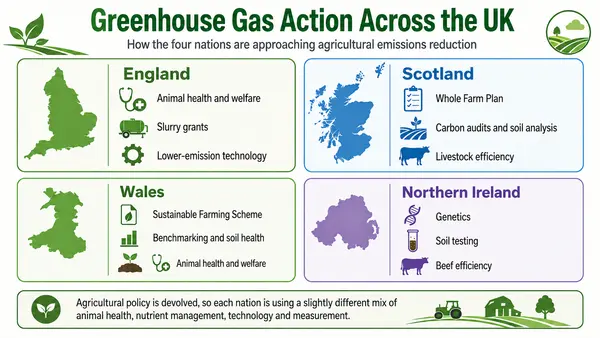
Similar principles are reflected in programmes elsewhere in the UK, including animal health planning within Scotland’s Whole Farm Plan and animal health and welfare requirements within the Welsh Sustainable Farming Scheme.
Slurry and manure management is receiving investment
Farmers are investing in improved slurry storage, more accurate application and equipment that retains a greater proportion of manure nutrients for crop use.
In England, the Farming Equipment and Technology Fund 2026 included support for slurry-testing and flow-monitoring equipment, automatic slurry collectors and low-emission spreading machinery.
Low-emission equipment such as dribble bars and trailing shoes can place slurry closer to the ground, reducing ammonia losses and retaining more nitrogen for grass and crops. Accurate flow monitoring can also reduce over-application and help farms make better use of slurry before purchasing additional fertiliser.
Previous rounds of England’s Slurry Infrastructure Grant have supported larger storage projects, including stores with impermeable covers. Although individual grant rounds open and close, the wider direction of policy is towards sufficient storage, covered stores, more accurate spreading and better nutrient utilisation.
Manure investment still needs to be assessed as a complete system. Capturing more nitrogen in storage is useful only if that nitrogen is subsequently applied at the correct rate, in suitable conditions and when plants can make effective use of it.
Methane-suppressing feeds are being developed and tested
The UK Methane Action Plan identifies methane-suppressing feed products as one of several possible ways to reduce methane from cattle digestion. It also emphasises animal health, breeding, productivity, manure management and research.
Feed products may be most practical in dairy and housed beef systems where a measured ration is provided every day. Their use is more difficult in grazing systems where cattle or sheep obtain most of their diet directly from pasture.
Research is continuing to determine how different measures perform in commercial conditions. The UK Dairy Carbon Network is testing combinations of breeding, feeding, forage, fertiliser and slurry management on 56 commercial dairy farms across the UK. Twenty of the participating farms are in Northern Ireland.
This is important because an intervention that works in isolation during a controlled trial may produce a different result when combined with the weather, forage, housing, labour and financial constraints of a working farm.
England: research, health and lower-emission equipment
The Farming Roadmap 2050 for England includes commitments to develop and test lower-emission farming practices, including measures addressing methane from livestock and nitrous oxide from soils.
Current action includes funded animal-health reviews, disease-control follow-ups, grants for selected livestock and slurry equipment, research into agricultural emissions and work to improve the consistency of farm environmental measurements.
Environmental support in England also encourages actions involving soil management, nutrient planning, hedgerows, woodland, habitats and reduced pollution. The exact schemes and application windows can change, so farmers need to consult the current guidance before making an investment decision.
Scotland: the Whole Farm Plan and livestock efficiency
Scotland introduced the first requirements of its Whole Farm Plan in 2025. Businesses receiving Basic Payment Scheme support are required to undertake two relevant baseline activities from:
- An Animal Health and Welfare Plan.
- A Biodiversity Audit.
- A Carbon Audit.
- An Integrated Pest Management Plan.
- Soil Analysis.
The Scottish Government intends businesses to have all relevant plans and audits in place by 2028, when nutrient-management planning is also expected to form part of the Whole Farm Plan.
Scotland’s Climate Change Plan for 2026–2040 places particular emphasis on livestock efficiency, animal health, improved fertility, soil health, nitrogen-use efficiency and emerging lower-carbon technologies.
It also includes the development of better cattle information through the MyHerdStats dashboard, investigation of selective breeding for lower-methane livestock and consideration of appropriate methane-suppressing feed products.
Changes to Scotland’s suckler beef support include a link with calving interval performance. This reflects the principle that reducing long unproductive periods can improve both business efficiency and emissions intensity.
Wales: the Sustainable Farming Scheme
The Welsh Sustainable Farming Scheme began on 1 January 2026. It is intended to support food production while helping farms improve productivity, respond to climate change and manage natural resources.
Its Universal Actions include areas such as soil health, benchmarking, continuous professional development and animal health and welfare. Benchmarking and soil testing can give farms a clearer starting point from which to improve livestock, nutrient and business performance.
Additional Optional and Collaborative support is intended to help farms build on the Universal Actions. Relevant areas include more targeted use of inputs, livestock health, water and nutrient management, habitats and action undertaken jointly across neighbouring farms or landscapes.
As with the schemes in the other nations, the measures are broader than greenhouse gas reduction alone. They combine food production, animal health, water quality, soil condition, biodiversity and climate resilience.
Northern Ireland: carbon, genetics and beef efficiency
Northern Ireland’s Sustainable Agriculture Programme includes several measures connected with agricultural emissions and resource efficiency.
These include:
- Improving the environmental efficiency of cattle through genetics.
- Reducing age at first calving and unnecessary replacement rates.
- Promoting more efficient fertiliser and slurry applications.
- Increasing the use of legumes and herbs to reduce fertiliser nitrogen.
- Researching methane-suppressing feed products and slurry additives.
- Exploring biomethane production from agricultural materials.
- Providing soil nutrient and carbon information to farmers.
The Beef Carbon Reduction Scheme uses support payments to encourage cattle to be finished within specified age limits. The aim is to reduce the number of additional days during which animals consume feed and produce methane before slaughter.
Northern Ireland’s Soil Nutrient Health Scheme is also providing soil analysis and baseline information about pH, major nutrients and estimated carbon stores. This can support more accurate nutrient planning and reduce unnecessary fertiliser use.
Progress should not be measured by technology alone
The most visible climate measures are often new products, machinery or large infrastructure projects. However, many of the changes already taking place are less dramatic:
- Reducing disease and mortality.
- Improving fertility and calving or lambing performance.
- Finishing animals at an appropriate age.
- Testing forage and balancing diets.
- Using clover and legumes.
- Testing soils and manures.
- Applying nutrients more accurately.
- Maintaining grassland, hedgerows and soil carbon.
- Recording performance more consistently.
These measures are already familiar to many farmers because they are connected to animal welfare, productivity and cost control. Their climate benefit is often the result of reducing waste rather than reducing food production for its own sake.
There is still a gap between policy and practical adoption
Government plans demonstrate that agricultural emissions are now receiving greater attention. Nevertheless, publishing a strategy or opening a grant scheme does not guarantee that a measure will be practical, affordable or effective on every farm.
Farmers need clear evidence about likely costs, expected savings, animal performance and the reliability of any claimed emissions reduction. Support must also recognise the differences between dairy, lowland beef, upland cattle, intensive finishing and hill sheep systems.
The direction of travel is clear: better animal health, more efficient production, improved manure and nutrient management, protection of soils and greater use of measurement. The challenge is to ensure that these changes are based on practical farm evidence, support food production and deliver genuine reductions rather than simply transferring emissions or costs elsewhere.
Where better records and measurements can help
Livestock greenhouse gas emissions cannot usually be measured simply by placing a meter beside every animal, slurry store or field. At farm level, emissions are generally estimated using information about livestock, production, feed, fertiliser, manure, energy and land management.
The quality of the resulting estimate therefore depends heavily on the quality of the information entered. Accurate records cannot remove emissions by themselves, but they can reveal where resources are being used efficiently, where losses may be occurring and whether changes in management are producing a genuine improvement.
Establishing a reliable starting point
Before a farm can demonstrate improvement, it needs a credible starting point or baseline. This might cover a calendar year, financial year or complete livestock production cycle, provided that the chosen period is clearly defined and used consistently.
Defra’s Food Data Transparency Partnership work on farm environmental measurement explains that carbon audits require farmers to assemble records including the amount and type of feed and fertiliser used, crop yields and product weights.
A useful farm baseline may therefore include:
- Average and peak livestock numbers.
- Animal births, purchases, sales, deaths and disposals.
- Liveweights, growth rates and carcase weights.
- Milk, meat or breeding output.
- Purchased feed and forage use.
- Manufactured fertiliser purchases and applications.
- Manure and slurry storage and spreading.
- Fuel and electricity consumption.
- Land use, cropping and grassland management.
Once a baseline has been established, the same categories can be measured again after management changes. Without a consistent baseline, it can be difficult to distinguish a real reduction from a change in the calculator, the reporting period, the farm boundary or the assumptions being used.
Distinguishing total emissions from emissions intensity
Farm emissions can be described in at least two important ways:
- Total emissions, representing the estimated emissions from the farm or enterprise during the reporting period.
- Emissions intensity, representing emissions per unit of output, such as per kilogram of liveweight, kilogram of carcase or litre of milk.
Both measures are useful, but they answer different questions. Improved fertility, faster growth or better feed conversion may reduce emissions per kilogram of food produced. Total emissions may nevertheless remain unchanged, or even increase, if livestock numbers or overall production increase at the same time.
Farm records should therefore retain both the inputs and the outputs. Recording livestock numbers without recording production provides only part of the picture. Equally, recording output without the feed, fertiliser, energy and animal time required to achieve it makes it difficult to assess how efficiently that output was produced.
Animal-level records can reveal hidden inefficiency
The greenhouse gas emissions associated with an animal begin long before it reaches the abattoir or enters the milking herd. Feed, grazing, housing, manure storage and general farm resources are required throughout the animal’s life.
Animal-level records can help identify avoidable periods during which resources are being consumed without the expected productive return. Particularly useful information includes:
- Date of birth and parentage.
- Calving or lambing history.
- Service dates and fertility outcomes.
- Health treatments and disease incidents.
- Weights and dates of weighing.
- Daily liveweight gain.
- Age at first calving.
- Calving interval.
- Mortality and reasons for loss.
- Date and reason for culling.
- Finishing age, carcase weight and grade.
AHDB’s beef and lamb key performance indicators use technical, financial and environmental measures to help producers identify which parts of suckler, beef-finishing and sheep enterprises are performing well and which require review.
For example, weight records may show that a particular group, breed or source of cattle consistently takes longer to finish. Fertility records may identify an excessive number of empty females or an extended calving period. Health records may show recurring disease or parasite problems that are reducing growth.
These are not only environmental concerns. They are often associated with additional feed, labour, housing and veterinary costs. Better records allow the environmental and financial effects to be considered together rather than treating carbon as an entirely separate farm issue.
Purchase and abattoir records can close the information gap
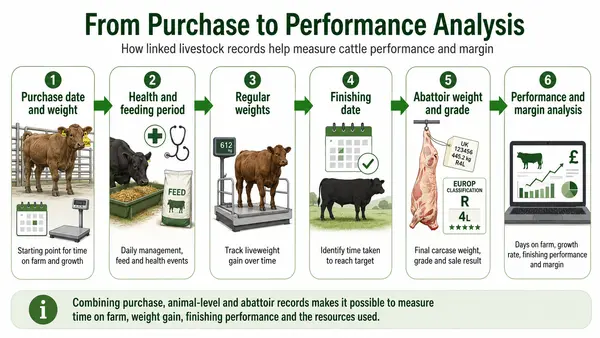
For purchased store cattle, an accurate purchase weight and date establish the starting point for measuring performance on the farm. Abattoir information provides the finishing date, carcase weight, grade and value. Together, these records can be used to assess:
- Time spent on the farm.
- Weight gained during the finishing period.
- Average daily gain.
- Carcase performance.
- Performance by breed, sex, source or management group.
- Estimated cost per head and per day.
- Margin and output achieved from the resources used.
Where markets and abattoirs provide electronic files, importing the data can reduce manual entry and improve accuracy. It can also make it practical to assess every animal rather than relying on a small sample or an overall group average.
Benchmarking helps put the figures into context
A farm’s figures become more useful when they can be compared with its own previous performance and, where appropriate, with similar enterprises. Benchmarking may reveal whether a result reflects the farming system, seasonal conditions or a performance issue that could be addressed.
AHDB’s Farmbench benchmarking system allows farms to compare physical and financial performance indicators with other businesses. AHDB describes benchmarking as a means of identifying areas of weakness as well as areas in which a business outperforms its peers.
Year-on-year comparisons should be treated carefully. Weather, forage quality, purchased livestock prices, disease outbreaks and changes in land area can all affect results. Maintaining consistent and detailed records allows these influences to be considered when interpreting the figures.
Feed and forage records improve methane estimates
Methane from cattle and sheep is closely related to feed intake, diet and animal performance. Useful records may include:
- Quantities and types of purchased feed.
- Feed delivery and usage dates.
- Forage analysis results.
- Silage and hay yields.
- Ration formulations.
- Estimated grazing periods.
- Animal weights and output during each feeding period.
These records help distinguish between additional feed that generates additional productive output and feed that is being used merely to support longer finishing periods, poor fertility or underperforming animals.
The Defra-funded UK Dairy Carbon Network is working with more than 50 commercial dairy farms to assess how practical measures involving breeding, feeding, forage, fertiliser and slurry management perform individually and in combination under real farm conditions.
This type of work is important because the result achieved under controlled research conditions may not be reproduced identically on every commercial farm. Measurement across different farming systems helps determine which measures are effective, practical and repeatable.
Nutrient and manure records support nitrous oxide reduction
Nitrous oxide emissions are influenced by the amount of nitrogen entering the farm, how it moves through livestock and manure systems, and when and where it is applied to land.
Useful nutrient records include:
- Fertiliser purchases and stock remaining.
- Product type and nutrient content.
- Field, date and application rate.
- Soil analysis results.
- Manure and slurry analysis.
- Estimated manure quantities.
- Storage periods and store capacity.
- Spreading method and weather conditions.
- Grass and crop yields.
The AHDB Nutrient Management Guide, RB209 provides guidance on soil testing, crop requirements, fertilisers and the nutrient value of organic materials.
Combining field records with livestock and manure information allows the farm to assess whether purchased fertiliser is genuinely needed after the nutrients supplied by slurry, manure and grazing animals have been taken into account.
Energy records identify direct carbon dioxide emissions
Fuel and electricity usually represent a smaller part of livestock farming’s direct greenhouse gas emissions than methane and nitrous oxide. They are, however, often among the easiest sources to measure because invoices, meter readings and machinery records are already available.
Records might include:
- Red and white diesel purchases.
- Electricity meter readings and invoices.
- Gas, oil and other heating fuels.
- Contractor operations.
- Renewable electricity generated and exported.
- Fuel use by enterprise where this can be separated reliably.
In England, the Farm Business Survey’s report on farm energy use found that 20% of surveyed farm businesses had completed a carbon audit by 2023/24, rising to 57% among dairy farms. These figures apply to England and should not be treated as a UK-wide estimate.
Carbon calculators are useful, but results require interpretation
Carbon calculators can organise farm information and convert it into an estimated greenhouse gas footprint. They can be particularly helpful for establishing a baseline, identifying the largest estimated sources and testing the possible effect of management changes.
However, a calculator result should not be treated as a perfectly precise measurement of every gas leaving the farm. Different tools may use different boundaries, assumptions, emissions factors and methods of accounting for soil or vegetation carbon.
Defra’s review of farm environmental measurement acknowledges that entering the same farm data into different carbon calculators can produce different results because their underlying methodologies are not yet fully consistent.
For meaningful year-on-year comparisons, a farm should therefore record:
- Which calculator and version was used.
- The reporting period.
- The farm and enterprise boundaries.
- The data entered.
- Any estimates or standard values used.
- The treatment of purchased feed, contractors and land use.
- Whether carbon removals or sequestration were included.
Using the same method consistently may initially be more useful for tracking farm progress than comparing headline results produced by several different calculators.
The UK Government’s Environmental Improvement Plan 2025 commits Defra to developing minimum technical requirements and standard calculation methodologies for actionable farm carbon audits by 2028.
Better farm data can also improve national estimates
National agricultural emissions figures are estimates constructed from livestock populations, production data, surveys, scientific research and emissions models. As better information becomes available, the methods and historic estimates may be revised.
For example, the Government’s 2026 changes to UK greenhouse gas emissions methodology included using newer slaughter-weight data to improve the estimated weight of dairy cattle. The change affected the calculated methane and nitrous oxide emissions attributed to dairy animals.
The same methodology update incorporated newer evidence concerning low-emission slurry-spreading equipment, grass yields, nitrogen uptake, sheep diets and grass energy content. This demonstrates that improved measurements do not merely support individual farm decisions; aggregated farm and industry data can also improve the national understanding of agricultural emissions.
Records should lead to action, not simply more paperwork
The purpose of better records is not to collect information for its own sake. A useful record should help answer a practical question, such as:
- Which cattle are taking longest to finish?
- Which breeding animals are failing to produce regularly?
- Where is mortality or disease reducing output?
- How much weight is being gained during each production stage?
- Is additional feed producing a worthwhile response?
- Are manure nutrients being credited before fertiliser is purchased?
- Which fields or livestock groups are improving?
- Has a management change reduced total emissions, emissions intensity or both?
Digital livestock records can bring information from movements, weights, health, breeding, purchases and abattoir returns together in one place. This can reduce repeated data entry and make it easier to analyse performance by animal, breed, source, field, group or year.
The most valuable measurements are often those that serve several purposes at once. A weight record can support feeding decisions, finishing targets, profit calculations and emissions-intensity estimates. Fertility records can support breeding decisions while identifying avoidable unproductive periods. Manure and fertiliser records can support compliance, nutrient planning, cost control and nitrous oxide reduction.
Better records will not make every carbon estimate exact. They can, however, replace assumptions with farm-specific evidence, reveal where improvements are possible and allow farms to demonstrate changes that have actually taken place.
As environmental reporting develops, farms with reliable historic records will be better placed to assess new requirements, challenge unsuitable assumptions and ensure that their performance is represented by evidence rather than by broad industry averages.
A balanced conclusion on food production and emissions
UK livestock farming produces nutritious food, supports rural employment, maintains farming communities and manages a substantial area of the country’s grassland and uplands. Cattle and sheep can also convert grass, forage and other materials that people cannot eat directly into meat, milk and other useful products.
Food production must therefore remain an important part of any discussion about agricultural greenhouse gas emissions. The UK Food Security Report identifies domestic production as the main source of food consumed in the UK, supplemented by international trade.
However, the importance of livestock farming does not mean that its emissions should be ignored. Methane from digestion and manure has a real warming effect, nitrous oxide from soils and nitrogen losses is powerful and long-lived, and farms also use fossil fuels and other purchased inputs that produce carbon dioxide.
An accurate discussion must therefore avoid two opposing but equally unhelpful claims:
- That cattle and sheep are effectively the same as fossil-fuel industries because all greenhouse gases can be expressed as carbon dioxide equivalent.
- That livestock emissions are harmless simply because their carbon is biological or because methane remains in the atmosphere for much less time than carbon dioxide.
Neither claim reflects the full scientific position. Carbon dioxide from normal animal respiration forms part of a relatively short biological carbon cycle. It is not the same as releasing additional carbon that has been stored underground for millions of years.
Biogenic methane nevertheless remains a powerful greenhouse gas while it is present in the atmosphere. Stable methane emissions may eventually maintain approximately stable methane-related warming, whereas increasing emissions cause additional warming and sustained reductions can lower methane’s contribution to warming.
Nitrous oxide presents a different challenge. It remains in the atmosphere for around a century and is closely connected to the management of fertiliser, manure, slurry, grazing livestock and soil conditions. Continuing nitrous oxide emissions add to atmospheric concentrations and cannot be treated in the same way as shorter-lived methane.
Some agricultural emissions are unavoidable, but many can be reduced
Cattle and sheep cannot digest forage without producing some methane, and nitrogen cannot pass through animals, manure and soils without some risk of loss. It is therefore unrealistic to suggest that food production can continue while all biological agricultural emissions are eliminated.
Research undertaken for the Climate Change Committee on greenhouse gas abatement in UK agriculture recognises that agricultural emissions cannot currently be reduced completely to zero because of the biological processes involved in crop and livestock production.
That does not mean that current emission levels are unavoidable. There is a considerable difference between emissions that are inherent in biological food production and emissions caused by poor health, infertility, unnecessary finishing days, wasted feed, surplus nitrogen, badly timed applications, leaking stores or inefficient energy use.
The practical objective should be to reduce these avoidable losses through:
- Better animal health, survival and fertility.
- Appropriate breeding and selection.
- Efficient growth and finishing.
- Good-quality forage and accurately balanced diets.
- Better manure and slurry storage.
- More accurate nutrient applications.
- Protection of soils, peat, grassland, hedgerows and trees.
- Lower fossil-energy use.
- Reliable records and measurements.
The UK Methane Action Plan similarly identifies a combination of improved animal health and welfare, breeding, feeding, manure management, technology and research rather than one universal solution for all livestock farms.
Efficiency should not be confused with simply producing more
Improving livestock efficiency can reduce the emissions associated with each kilogram of meat or litre of milk. Healthier animals, better fertility, faster appropriate growth and reduced mortality mean that a greater proportion of feed and other resources results in useful food production.
This is important, but emissions intensity should not be considered in isolation. A farm may reduce emissions per kilogram of output while its total emissions remain unchanged or increase because livestock numbers or overall production have risen.
Both measures should therefore be considered:
- Emissions intensity shows how efficiently food is being produced.
- Total emissions show the farm or sector’s overall contribution during the reporting period.
A credible assessment should report both where possible. This avoids penalising farms that improve productivity, but it also prevents efficiency figures from concealing an increase in overall emissions.
Reducing UK production does not automatically reduce global emissions
Food demand does not necessarily disappear when domestic production falls. If the UK produces less beef, lamb or dairy food while consumption remains unchanged, more food may be imported.
The environmental result will then depend on how efficiently the imported food was produced, any land-use change connected with it, processing and transport requirements, and whether production standards can be verified. A reduction in UK territorial emissions is not necessarily a reduction in the emissions associated with UK consumption.
This does not justify retaining inefficient production. It does mean that policy should consider food consumption, imports and supply chains alongside emissions recorded within the UK. Moving production elsewhere should not be mistaken automatically for solving the underlying environmental problem.
The UK Food Security Report recognises that food security depends on a combination of resilient domestic production and international trade. Climate policy and food policy should therefore be considered together rather than as separate objectives.
Responsibility extends beyond the farm gate
Farmers have direct control over many livestock, soil, manure and energy decisions, but responsibility for food-system emissions does not end or begin entirely at the farm gate.
Processors, retailers, food-service businesses, consumers and government policy all influence:
- The products that are demanded.
- The specifications farmers must meet.
- The prices paid for food.
- The value given to environmental improvements.
- Food waste throughout the supply chain.
- Investment in research, infrastructure and advice.
Farmers cannot be expected to carry the full cost of new equipment, measurement and lower-emission practices if the supply chain attaches no value to the resulting improvement. Equally, environmental claims made by processors and retailers should be based on genuine changes rather than placing additional recording requirements on farms without a clear purpose.
Reliable evidence is essential
Agricultural emissions are estimated rather than measured perfectly. Results depend on livestock information, production figures, feed and fertiliser records, emissions factors and assumptions about soils, manure and land management.
Poor or incomplete records may cause a farm to be represented by broad industry averages that do not reflect its actual performance. Better animal-level and field-level information can provide a stronger basis for identifying inefficiency, demonstrating improvement and challenging unsuitable assumptions.
Measurements must nevertheless be interpreted honestly. Carbon calculators can produce different results because they use different boundaries and methods. Soil carbon can be difficult to measure and may not continue increasing indefinitely. An improvement in emissions intensity does not always reduce total emissions, and a reduction in one gas or pollution pathway can sometimes increase another.
Credible environmental reporting should therefore be:
- Transparent about the method used.
- Consistent between reporting periods.
- Clear about estimates and assumptions.
- Based on farm-specific information wherever practical.
- Honest about uncertainty.
- Connected to measurable management action.
Food production and emissions reduction can support each other
The most constructive way forward is not to deny livestock emissions or to portray livestock farming as having no future. It is to concentrate on measures that reduce waste, improve animal welfare, make better use of feed and nutrients, protect natural resources and maintain productive farms.
Many of these objectives already align. An animal that remains healthy, conceives reliably and reaches its production target efficiently generally uses fewer resources than one affected by disease, infertility or poor growth. Nitrogen used by grass and crops is more valuable than nitrogen lost to air or water. Slurry used accurately as a fertiliser is more useful than slurry treated merely as waste. Fuel that is not unnecessarily consumed saves both carbon and money.
Government pathways envisage continuing reductions in agricultural emissions rather than assuming that the sector can remain unchanged. The Climate Change Committee’s Seventh Carbon Budget sets out a pathway involving lower agricultural emissions through a combination of farm practices, technology, land management and wider changes across the food system.
The transition must be practical and evidence-based. It should recognise the different circumstances of dairy, lowland beef, upland cattle, beef-finishing and hill sheep systems. It must also allow sufficient time for investment, research and the replacement of buildings and equipment.
UK livestock farming has already reduced some emissions since 1990, but further progress is required. That progress should be measured by genuine reductions in avoidable methane, nitrogen and fossil-energy losses—not by simplistic comparisons, unverified offsets or the transfer of production to another country.
The balanced objective is clear: continue producing high-quality food while reducing avoidable emissions, protecting existing carbon stores and using animals, feed, nutrients and energy as efficiently as possible.
Better livestock management and better records will not remove every greenhouse gas associated with agriculture. They can, however, help farms identify where improvement is possible, demonstrate what has already been achieved and ensure that future decisions are based on evidence rather than assumption.
Frequently Asked Questions
How much of the UK’s greenhouse gas emissions come from agriculture?
In 2024, UK agriculture produced approximately 46.5 million tonnes of carbon dioxide equivalent, representing about 12.5% of the UK total. This includes emissions from livestock, agricultural soils, manure management, machinery and other farm activities, so it should not be described as a livestock-only figure.
Which greenhouse gases are most important in UK livestock farming?
Methane and nitrous oxide are the most significant agricultural greenhouse gases. Methane is produced mainly by cattle and sheep digestion and manure, while nitrous oxide arises largely from nitrogen cycling through soils, fertiliser, manure, slurry, urine and dung. Direct agricultural carbon dioxide emissions are comparatively smaller.
Does the carbon dioxide breathed out by cattle add to global warming?
The carbon dioxide breathed out by cattle and sheep forms part of the relatively short biological carbon cycle. Its carbon was recently absorbed from the atmosphere by grass and other plants, so animal respiration is not normally counted as a new net addition of carbon dioxide. Farms can still produce fossil carbon emissions through fuel, electricity, machinery, fertiliser manufacture and purchased inputs.
Is biogenic methane harmless because it comes from a natural cycle?
No. Biogenic describes where the carbon came from, not whether the gas affects the climate. Livestock methane contains carbon that was recently absorbed by plants, but methane remains a powerful greenhouse gas while it is present in the atmosphere.
Does livestock methane disappear after 12 years?
Not precisely. Methane has an average atmospheric lifetime of about 12 years, but individual methane molecules do not all disappear on a fixed date. Methane is continually being emitted and removed through atmospheric chemical reactions.
Why does it matter whether methane emissions are rising or falling?
Rising methane emissions cause additional warming. Broadly stable emissions can eventually maintain approximately stable methane-related warming, while sustained reductions can lower atmospheric methane and reduce its contribution to warming. Stable emissions are therefore not harmless, but they behave differently from continuing fossil carbon dioxide emissions.
Why is nitrous oxide important to livestock farming?
Nitrous oxide is powerful, remains in the atmosphere for around a century and is closely connected to nitrogen management. It can arise from fertiliser, manure, slurry, grazing livestock and nitrogen lost through leaching or run-off. Agriculture accounted for 59% of UK nitrous oxide emissions in 2024.
Can improving livestock efficiency reduce emissions?
Better animal health, fertility, survival, growth, finishing performance and feed efficiency can reduce emissions per kilogram of meat or litre of milk. However, lower emissions per unit of production do not necessarily reduce total farm emissions if livestock numbers or total production increase.
Can grassland and soil carbon offset all livestock emissions?
No. Grassland, soils, hedgerows and trees can store substantial amounts of carbon, and improved management may increase some carbon stores. However, sequestration generally slows over time and stored carbon can be released again if soils are cultivated, peat is drained or land management changes. It should not automatically be used to cancel continuing methane and nitrous oxide emissions.
What can livestock farms do to reduce greenhouse gas emissions?
Practical measures include improving animal health and fertility, reducing unnecessary finishing days, producing better-quality forage, avoiding excessive dietary protein, managing slurry and manure more effectively, applying nutrients accurately, protecting soil carbon and reducing unnecessary fossil-energy use. The most suitable combination will depend on the individual farming system.
How can better farm records help reduce emissions?
Records of animal weights, growth, fertility, health, mortality, feed, manure, fertiliser, energy use and production can identify avoidable inefficiency and establish a reliable baseline. They also allow farms to assess whether management changes have reduced total emissions, emissions per unit of output or both.
Would reducing UK livestock production automatically reduce global emissions?
Not necessarily. If UK production falls while consumption remains unchanged, additional meat or dairy products may be imported. The overall environmental effect then depends on how and where that food is produced, including land-use change, production efficiency, transport and the standards applied within the exporting country.
Can livestock farming ever have no greenhouse gas emissions?
Some biological emissions are unavoidable while cattle, sheep, grass and crops continue to be produced. The realistic objective is to reduce avoidable emissions and resource losses while continuing to produce food efficiently, protecting existing carbon stores and improving animal welfare.
Explore the Cattle Software |
Explore the Sheep Software |
View Pricing
← Back to Farm Insights Blog